Not as a rule for everyone. The "8 × 8" rule (eight 8-oz glasses, about 1.9 litres) has no scientific origin anyone could trace. What you need depends on your size, sex, activity and climate: for many adults 8 glasses is too little, for some it's more than they need.
When I was working out the daily goal for Hydra, the 8 glasses a day rule was the obvious place to start. Everyone knows it, it's easy to remember, and it would have been one line of code. But I wanted the number in the app to come from somewhere, so I went looking for where it comes from. The short version: nowhere solid. Here is what I found, and what I built instead.
Where the 8 glasses a day rule comes from
The rule usually goes like this: drink eight glasses of 8 oz each, 64 oz in total, which is about 1.9 litres. With metric glasses of 250 ml it becomes a round 2 litres. It's simple, round and easy to remember.
In 2002 Heinz Valtin published a review with a title that says it all: "Drink at least eight glasses of water a day." Really? Is there scientific evidence for "8 × 8"? He looked for the origin of the rule and for studies behind it, and found no scientific source it could be traced to. The number may be in the right range for some people, but nobody ever showed that it is the right amount for everyone.
That doesn't make water less important. It means the rule is a slogan, not a measurement.
What health bodies actually recommend
The two big reference points are the European Food Safety Authority (EFSA) and the US Institute of Medicine. Both talk about total water: what you drink plus the water in your food.
- EFSA (2010): 2.0 litres a day for women and 2.5 litres for men, total. About 70–80% of it comes from drinks and 20–30% from food.
- Institute of Medicine (2005): 2.7 litres a day for women and 3.7 litres for men, total. From drinks, that's about 2.2 litres for women and 3.0 litres for men.
So already, the two most quoted recommendations disagree with each other, and both treat men and women differently. A single number for every adult doesn't survive the first look. Here is how the 8 × 8 rule compares with them, and with a few profiles from the formula in Hydra (drinks only):
| Who | Drinks a day | In oz | vs 8 × 8 |
|---|---|---|---|
| The 8 × 8 rule | 1 900 ml | 64 oz | — |
| EFSA, women | 1 400–1 600 ml | 47–54 oz | less |
| EFSA, men | 1 750–2 000 ml | 59–68 oz | about the same |
| US (IOM), women | 2 200 ml | 74 oz | more |
| US (IOM), men | 3 000 ml | 101 oz | more |
| 50 kg woman, sitting, cool climate | 1 500 ml | 51 oz | less |
| 60 kg woman, slightly active | 2 000 ml | 68 oz | about the same |
| 80 kg man, active | 3 550 ml | 120 oz | almost double |
| 85 kg man, very active, hot climate | 4 700 ml | 159 oz | about 2.5× |
The EFSA rows are the 70–80% of total water that comes from drinks. Hydra's goal for an average adult lands between the European and the US numbers.
Why one number can't fit everyone
The clearest answer came in 2022, in a study published in Science. Researchers measured how much water thousands of people in many countries actually turn over in a day. Water turnover went up with body size, with physical activity, with heat and humidity, and it was higher in men. Their conclusion on the old rule was blunt: 8 glasses is too high for many people and too low for others.
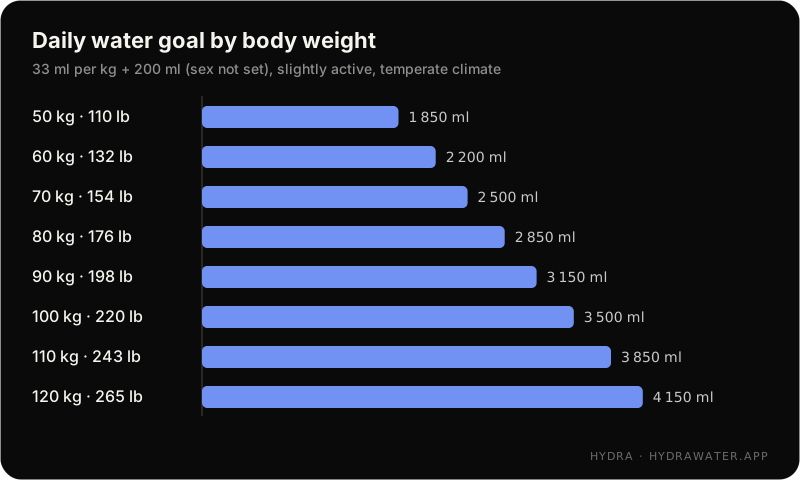
Body size alone moves the number a lot. That is why Hydra starts from about 33 ml per kg of body weight, roughly half an ounce per pound, which fits a typical, lightly active adult. I wrote a full guide, with a table in kg and lb, on how much water to drink for your weight.
Who needs more than 8 glasses
Most of the adjustments in the formula push the number up, not down:
- Bigger bodies. Every extra 10 kg (22 lb) adds about 330 ml.
- Men. At the same weight, men turn over a bit more water: about 375 ml in the 2022 study, half a litre in the EFSA numbers. Hydra adds 400 ml.
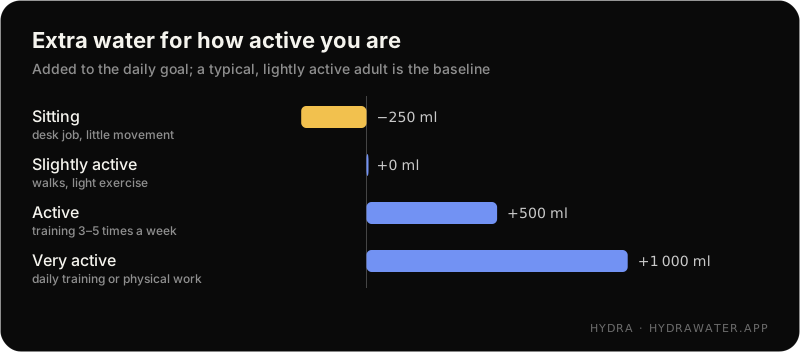
- Active people. Training 3–5 times a week adds 500 ml; daily training or physical work adds a full litre, because very active people turn over about a litre more water a day. Workouts themselves come on top; see how much to drink when you exercise.
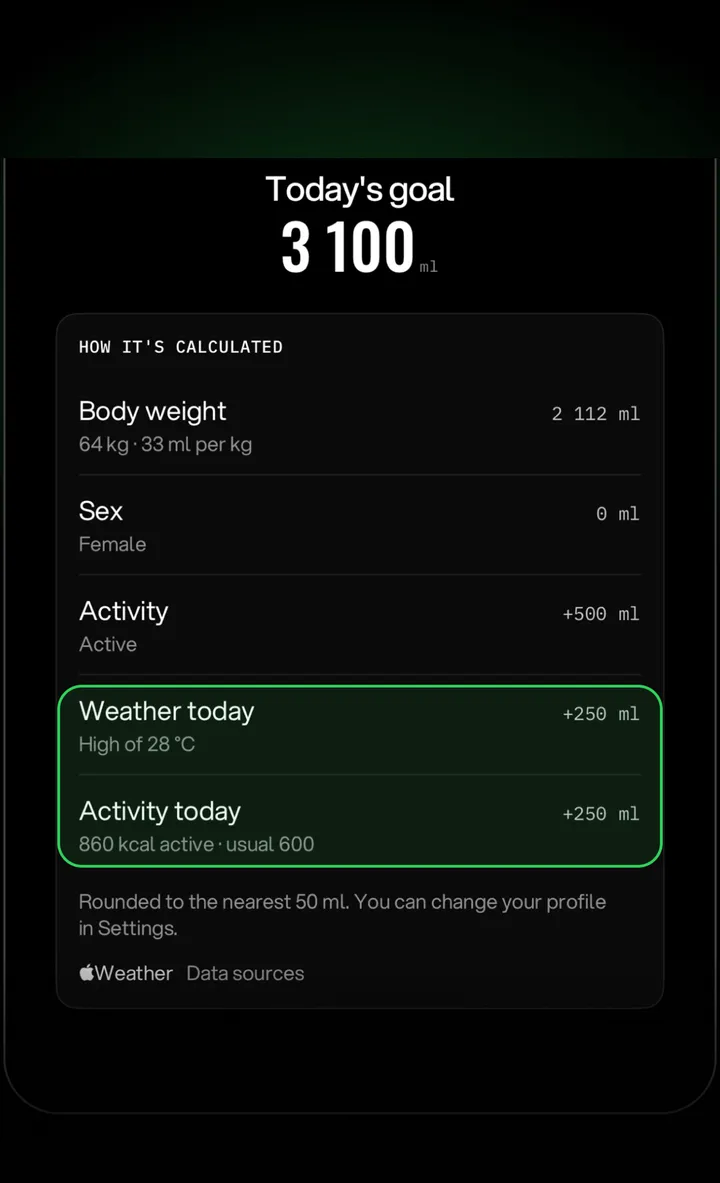
- Hot climates and hot days. Living somewhere hot adds 500 ml; a single hot day adds 250 to 750 ml depending on the high. More in the guide to drinking enough in hot weather.
- Pregnancy and breastfeeding. About 300 ml more when pregnant, 700 ml more when breastfeeding.
Who may need less
A small, sedentary adult in a cool climate can need less than 8 glasses. Take a 50 kg (110 lb) woman who sits most of the day in a cool place: the formula gives about 1 200 ml. Hydra never sets a goal below 1 500 ml (51 oz), so that's where she lands, still well under 1.9 litres.
Some people are told by their doctor to drink less, for example with certain heart or kidney conditions. In that case, your doctor's number wins over any rule or app. And for everyone: more isn't automatically better. Drinking very large amounts in a short time can dilute the sodium in your blood, which is dangerous. Spread your drinks over the day and don't force yourself far past thirst.
What counts towards the total
The rule says "glasses of water", and many people take that literally, as if only plain water counts. It doesn't work that way. Coffee and tea hydrate about as well as water in normal amounts; I went through the studies in whether coffee dehydrates you. Juice and soda count like water, milk a little more. Alcohol is the exception: beer counts less, wine about breaks even, and spirits take water away, as explained in how alcohol affects hydration.
Then there's food. Fruit, vegetables and soups are mostly water, and food gives about 20–30% of your total water. The drink amounts above already leave it out, so you don't subtract it; more on that in whether food counts towards your water intake.
What I built into Hydra instead
Hydra doesn't use 8 glasses. The standard goal in the free version is 2 500 ml (about 85 oz, ten 250 ml glasses), which is what the formula gives for a lightly active 70 kg adult in a temperate climate. With Pro, the goal is worked out from your own weight, sex, activity and climate, and it can adapt each day to your Apple Health activity and the local weather. Tap Goal ⓘ and you see every line that went into it, so you never have to take the number on faith.
If you'd like your own number right now, without the app, the water intake calculator runs the exact same formula in your browser, in ml or oz.
Your number, not the 8 × 8 rule
Hydra works out a daily goal from your weight, sex, activity and climate, and counts every drink by how much it really hydrates. Free on iPhone and Apple Watch.