When you exercise, drink enough to cover what you sweat: usually about 0.5 to 2 litres (17 to 68 oz) an hour. Try not to lose more than about 2% of your body weight in a session, and afterwards drink about 1.5 litres for every kilo you lost. For most workouts, water is all you need.
Why exercise changes how much water you need
When you move, your muscles make heat, and sweating is how your body gets rid of it. That sweat is water you drank earlier, and it has to be replaced. The American College of Sports Medicine's position stand on exercise and fluid replacement puts typical sweat rates at about 0.5 to 2 litres per hour. Where you land in that range depends on how hard you work, how hot it is and how big you are.
That's a wide range, and it's why one number for everyone doesn't work. A brisk walk on a cool morning and an hour of intervals on a hot afternoon are not the same day for your body. A large 2022 study that measured thousands of people in many countries saw the same thing across whole days: water turnover rises with physical activity, and very active people turn over about a litre a day more than sedentary people of the same weight.
How to find out how much you sweat
The simplest tool is your bathroom scale. Weigh yourself just before a workout and again right after, in the same light clothes, towelled dry. One kilo of weight lost is about one litre of sweat, so the difference shows roughly what you lost. If you drank during the session, add that too, and you have your own sweat rate for that kind of workout.
Two numbers from the same guidance turn this into something you can use:
- Aim to lose no more than about 2% of your body weight during exercise. For someone who weighs 70 kg (154 lb), that's 1.4 kg (about 3 lb).
- Afterwards, drink about 1.5 litres for every kilo you lost, roughly 23 oz per pound. A little more than you lost, not the same amount.
You don't have to weigh yourself after every session. Doing it a few times for your usual workouts, once in summer and once in winter, gives you a feel for your own numbers. After that, thirst usually tells you the rest.
What to drink during and after a workout
For most workouts (an hour at the gym, a run, a class) plain water is all you need. Drink something before you start, sip when you're thirsty, and have a proper drink afterwards.
For long or very sweaty sessions, drinks with sodium help. You lose salt in sweat as well as water, and a drink with electrolytes replaces both. I go into it in more detail in whether electrolytes hydrate better than water. In Hydra, an electrolyte drink (oral rehydration solution) counts ×1.5, because a 2016 study found the body keeps more of it than plain water.
What isn't better is drinking far more than you sweat. Very large amounts in a short time can dilute the sodium in your blood (hyponatremia), which is dangerous. The scale is the honest check here too: if you weigh more after a workout than before, you drank more than you needed. And if you have a heart or kidney condition, follow your doctor's advice on fluids rather than any general rule, including the ones here.
How Hydra adds water for exercise
When I built the daily goal, I wanted exercise to show up in two ways: how active you are in a normal week, and how active you were today.
The first is the activity level you pick when you set up the app. The base is 33 ml per kg of body weight (more on that in how much water to drink for your weight), which fits a typical, lightly active adult. Your activity level then moves the goal up or down:
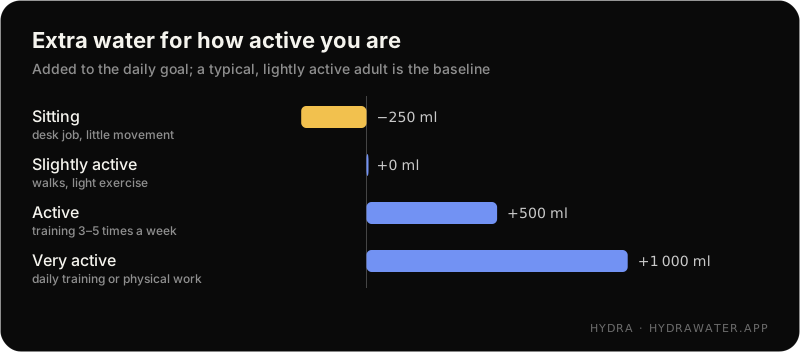
| Activity level | Goal adds | Active energy it assumes |
|---|---|---|
| Sitting | −250 ml | 200 kcal/day |
| Slightly active | 0 ml | 350 kcal/day |
| Active (3–5×/week) | +500 ml | 600 kcal/day |
| Very active (daily) | +1 000 ml | 900 kcal/day |
Why these numbers? The 2022 study found that very active people turn over about a litre a day more than sedentary people of the same weight. So "very active" gets the full litre (34 oz), "active" gets half of it (17 oz), and sitting all day takes a little off. I kept them round on purpose: a goal is a direction for your day, and a round number is easier to trust than one that pretends to be precise to the millilitre. You can try your own level in the water intake calculator, which uses the same formula as the app.
What happens on a workout day
Your activity level describes a normal week. A long Saturday ride is not a normal day, though. With Activity from Apple Health (part of Hydra Pro), the app reads your active calories and adds about 1 ml of water for every kcal above what your activity level already assumes. The 1 ml per kcal comes from the US Institute of Medicine's reference values for water.
The "above what it already assumes" part is the bit I care about most. If you told the app you're active, your goal already includes water for about 600 kcal of active energy a day. Counting those calories again would give you the same water twice. So only the extra counts, in steps of 50 ml, and never more than +1 000 ml in a day. The cap keeps the goal something you can drink comfortably over a day; after a really big effort, the scale and the 1.5 litres per kilo rule are the better guide.
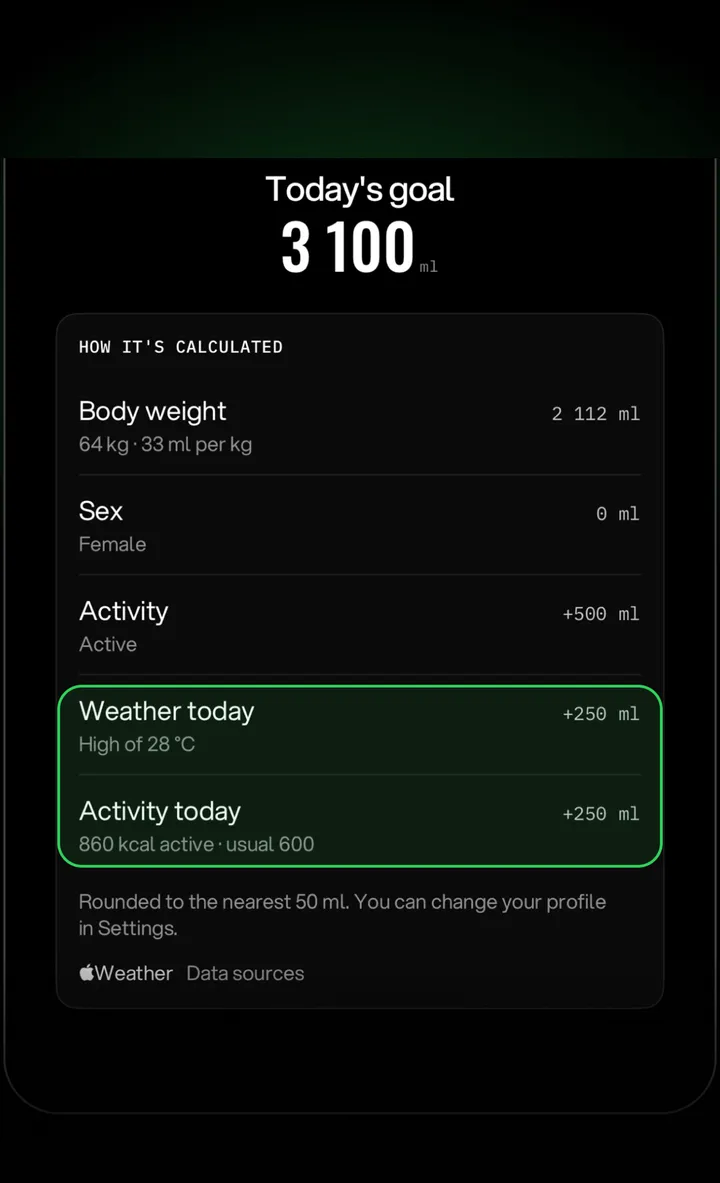
Here's the example from the screenshot. A woman of 64 kg who trains three to five times a week starts at 2 112 ml from her weight. "Active" adds 500. It's 28 °C (82 °F) outside, so the hot-day bonus adds 250; I explain that one in how much water to drink in hot weather. Her watch recorded 860 kcal of active energy against the usual 600, so 260 kcal extra, which becomes +250 ml. Total: 3 112, rounded to 3 100 ml (about 105 oz).
I wanted the breakdown to be one tap away for a simple reason: when the number goes up, you should see why. A goal you understand is a goal you actually follow.
Keeping up through the day
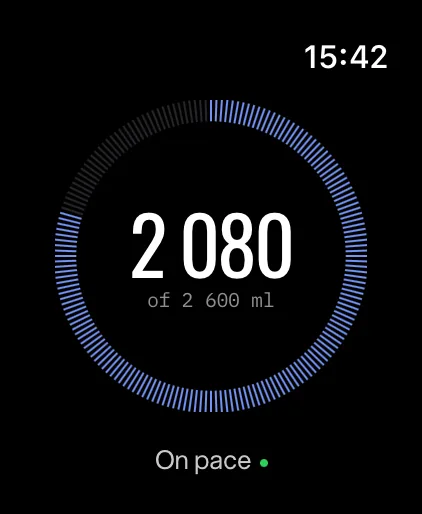
The goal is a daily total, not something to drink in one go. Spread it out: some before the workout, some during if it's long, the rest after and through the evening. On the Today screen, Hydra shows whether you're on pace for the time of day, and the Apple Watch ring shows the same, so you can check between sets without reaching for your phone. I wrote a separate guide on tracking your water on Apple Watch.
And the coffee before the gym counts. In normal amounts it hydrates about as well as water, which I explain in does coffee dehydrate you.
What to take from it
- Expect to sweat about 0.5 to 2 litres an hour when you exercise, more in heat and at higher intensity.
- Weigh yourself before and after a few typical workouts to learn your own numbers.
- Try not to lose more than about 2% of your body weight; afterwards, drink about 1.5 litres per kilo lost.
- Water is fine for usual workouts; add electrolytes for long or very sweaty ones.
- Don't drink far past thirst. More is not better.
A water goal that follows your training
Hydra adds water for your activity level and, with Apple Health, for the workouts you actually did, and shows you every line. Free on iPhone and Apple Watch.