Drink about 33 ml of water per kg of body weight a day (about 0.5 oz per lb), then adjust for sex, activity and heat. A lightly active 70 kg (154 lb) adult needs about 2 500 ml (85 oz) of drinks a day.
When I started building Hydra, the first question was the one you are asking: how much water should I drink for my weight? A fixed number for everyone felt wrong, because a 50 kg person and a 100 kg person are not running the same body. So the goal in the app starts from your weight and then adds or takes away water for the few things that really change it. This article walks through all of it, with the same numbers the app uses.
The formula: 33 ml per kg, or half an ounce per pound
The base is 33 ml per kilogram of body weight. In pounds, that is about 0.5 oz per lb, which is easy to do in your head: halve your weight in pounds and you have ounces.
Why 33 and not 30 or 40? It fits a typical, lightly active adult: someone who walks around during the day but doesn't train hard. For an average weight, that lands between what the European and the US health bodies suggest people drink. The European Food Safety Authority sets total water at 2.0 litres a day for women and 2.5 litres for men, about 70–80% of it from drinks. The US Institute of Medicine suggests about 2.2 litres from drinks for women and 3.0 litres for men. A per-kilo number lets the goal follow your size instead of an average person's.
One more detail: the goal is always rounded to the nearest 50 ml and kept between 1 500 and 5 000 ml a day, so very light or very heavy people don't end up with a number that makes no sense.
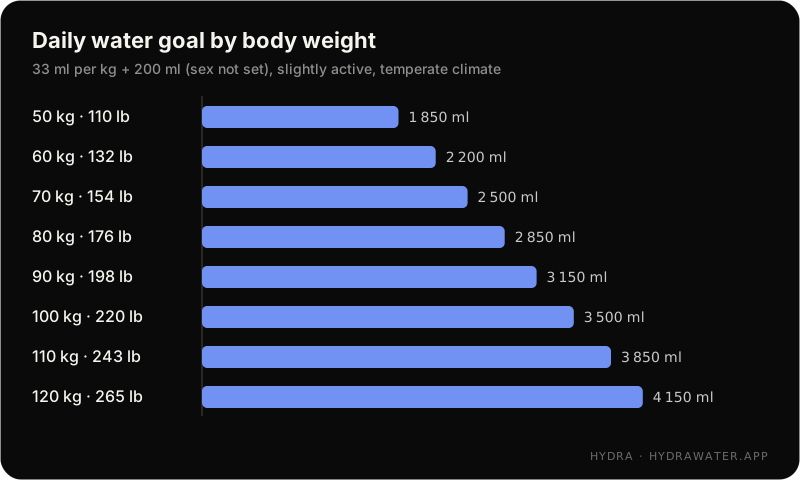
Water intake by weight: the full table
Here is the daily goal for weights from 45 to 120 kg. It uses the app's defaults: sex not set, slightly active, temperate climate. That is 33 ml per kg plus 200 ml, then rounded.
| Weight (kg) | Weight (lb) | Goal (ml) | Goal (oz) |
|---|---|---|---|
| 45 kg | 99 lb | 1 700 ml | 57 oz |
| 50 kg | 110 lb | 1 850 ml | 63 oz |
| 55 kg | 121 lb | 2 000 ml | 68 oz |
| 60 kg | 132 lb | 2 200 ml | 74 oz |
| 65 kg | 143 lb | 2 350 ml | 79 oz |
| 70 kg | 154 lb | 2 500 ml | 85 oz |
| 75 kg | 165 lb | 2 700 ml | 91 oz |
| 80 kg | 176 lb | 2 850 ml | 96 oz |
| 85 kg | 187 lb | 3 000 ml | 101 oz |
| 90 kg | 198 lb | 3 150 ml | 107 oz |
| 95 kg | 209 lb | 3 350 ml | 113 oz |
| 100 kg | 220 lb | 3 500 ml | 118 oz |
| 105 kg | 231 lb | 3 650 ml | 123 oz |
| 110 kg | 243 lb | 3 850 ml | 130 oz |
| 115 kg | 254 lb | 4 000 ml | 135 oz |
| 120 kg | 265 lb | 4 150 ml | 140 oz |
If you are a woman, take off 200 ml; if you are a man, add 200 ml (then round to the nearest 50). For a 60 kg woman that gives 2 000 ml (68 oz); for an 80 kg man, 3 050 ml (103 oz).
Why weight is only the start
The best recent look at this is a 2022 study in Science that measured how much water thousands of people in many countries actually turn over in a day. Water turnover went up with body size, as you'd expect, but also with physical activity, with heat and humidity, and in men. That is exactly the list of things Hydra adjusts for, and it is also why the old rule of 8 glasses a day is too much for some people and too little for others.
Sex
At the same weight, men need a bit more. The 2022 study found about 375 ml more; the European recommendations differ by half a litre. In Hydra, Male adds 400 ml, Female adds nothing, and if you'd rather not say, the app adds 200 ml, the middle of the two, so nobody ends up far off.
Activity
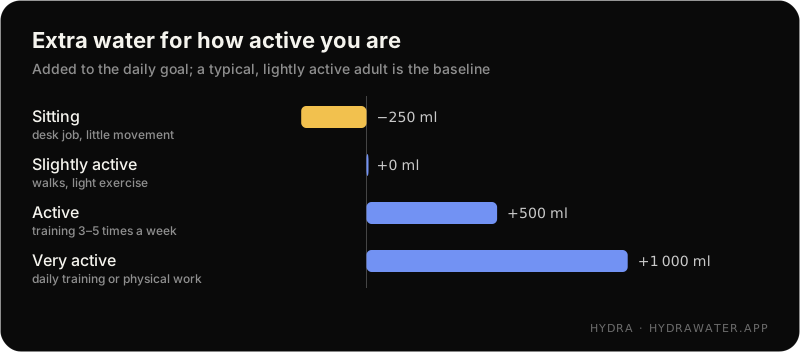
This is the biggest lever. The same study found that very active people turn over about a litre more water a day than sedentary people of the same weight, so the very active level adds a full litre.
On days you train, you also lose water in sweat, anywhere from about half a litre to two litres an hour. I wrote a separate guide on how much water to drink around a workout, because that is about the session itself, not your everyday goal.
Climate and hot days
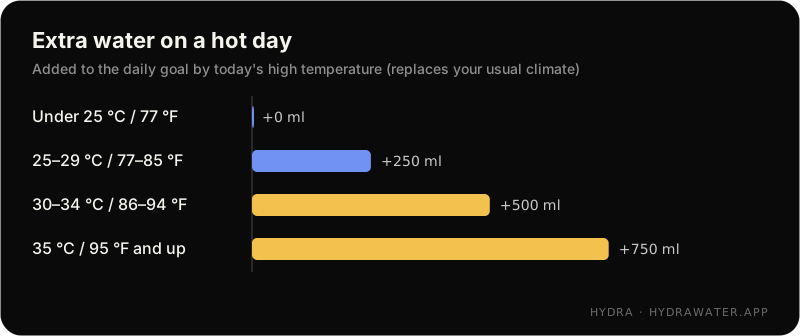
Where you live matters: a cool climate takes off 200 ml, a temperate one changes nothing, a hot one adds 500 ml. In Hydra Pro, the goal can also follow today's weather: the day's high temperature replaces your usual climate for that day.
If summer is the season you struggle with, there is more in the article on drinking enough in hot weather.
Pregnancy and breastfeeding
Pregnancy adds 300 ml a day and breastfeeding adds 700 ml, in line with the European and US recommendations. I go through the reasons in the guide to water intake when pregnant or breastfeeding.
Worked examples
Here is how the pieces add up for a few real-looking profiles, using the same formula as the app:
- 70 kg (154 lb), sex not set, slightly active, temperate: 2 310 + 200 = 2 510 → 2 500 ml (85 oz), about ten 250 ml glasses. This is also the standard goal in the free version of Hydra.
- 60 kg (132 lb) woman, slightly active, temperate: 1 980 → 2 000 ml (68 oz).
- 85 kg (187 lb) man, very active, hot climate: 2 805 + 400 + 1 000 + 500 = 4 705 → 4 700 ml (159 oz).
- 64 kg (141 lb) woman, active, on a 28 °C (82 °F) day: 2 112 + 500 + 250 = 2 862 → 2 850 ml (96 oz).
Notice how far apart those are: from 2 to almost 5 litres. Body weight explains part of it, and how you live explains the rest.
How Hydra shows your goal, line by line
I didn't want the goal to be a mystery number. In the app, tap Goal ⓘ and you see every line that went into it: body weight, sex, activity, climate or today's weather, and, in Pro, today's activity from Apple Health.
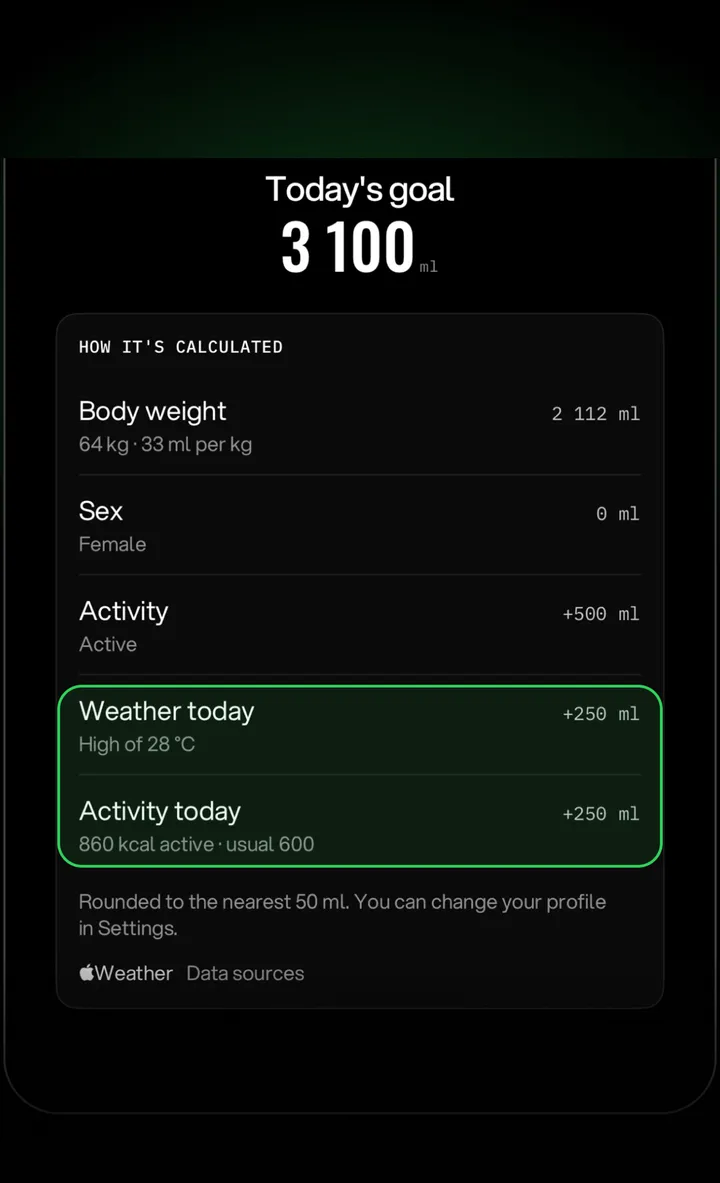
That last line works with about 1 ml of water per kcal of active energy, the ratio the Institute of Medicine uses, but only for the calories above what your activity level already assumes. For "Active" that is 600 kcal, so 860 kcal adds about 260 ml, rounded to 250. It never adds more than 1 000 ml. Hydra can also read your weight from Apple Health, so the base line stays current when your weight changes.
The goal is for drinks, not food
Everything above is water you drink. The water in your meals comes on top of it, so you don't need to subtract it; I explain why in the article on whether food counts towards your water intake. Coffee and tea count like water, milk a little more, and alcohol less.
More is not always better, either. Drinking very large amounts in a short time can dilute the sodium in your blood, which is dangerous. Spread your drinks over the day and don't force yourself far past thirst. If you have a heart or kidney condition, your doctor may want you to limit fluids, and their number wins over any formula.
To get your own number in a few seconds, the water intake calculator uses the exact formula from the app, in kg or lb.
A goal that fits your body
Hydra sets your daily goal from your weight, sex, activity and climate, and shows every line of it. Free on iPhone and Apple Watch.