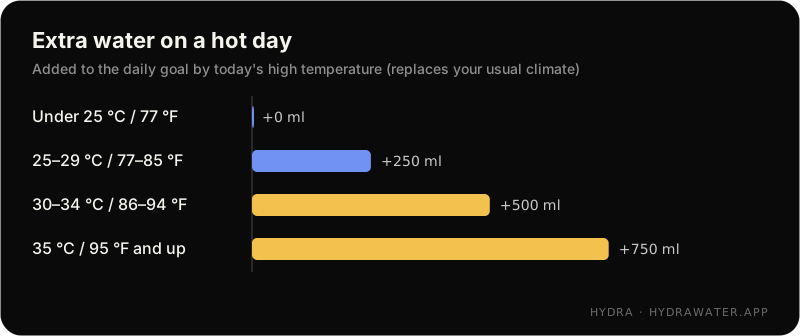
In hot weather you need more water than usual, because heat and humidity raise how much water your body goes through. Hydra adds 250 ml (8 oz) on a 25–29 °C (77–85 °F) day, 500 ml (17 oz) at 30–34 °C (86–94 °F) and 750 ml (25 oz) from 35 °C (95 °F). Start early and spread it through the day.
Why heat raises your water needs
Your body cools itself by sweating. When the air is hot, it has to sweat more to stay at the same temperature, and that water has to come back from what you drink. Humidity adds to it.
The clearest picture comes from a 2022 study in Science that measured how much water thousands of people in many countries actually go through in a day. Water turnover went up with heat and humidity, as well as with physical activity, body size, and in men. The same study found the old eight-glasses rule too high for many people and too low for others; I go into that in whether you really need 8 glasses of water a day.
Heat and exercise add up, too. During exercise most people sweat about 0.5 to 2 litres an hour, and the top of that range is where you land when it's hot. If you train outdoors in summer, read how much water to drink when you exercise as well.
How much more to drink on a hot day
When I built Hydra's goal, I split heat into two settings, because "where you live" and "what today is like" are different questions.
The first is your climate: cool takes 200 ml off the goal, temperate leaves it as it is, and hot adds 500 ml (17 oz). It's a setting you choose once and forget, and it's in the water intake calculator too, so you can see what it does to your own number.
The second is the hot-day bonus, part of Local weather in Hydra Pro. Every day, the app looks at today's high temperature and adds water in steps:
| Setting | When it applies | Goal adds |
|---|---|---|
| Climate: cool | Every day | −200 ml |
| Climate: temperate | Every day | 0 ml |
| Climate: hot | Every day | +500 ml |
| High of 25–29 °C (77–85 °F) | That day only | +250 ml |
| High of 30–34 °C (86–94 °F) | That day only | +500 ml |
| High of 35 °C (95 °F) and up | That day only | +750 ml |
With Local weather on, today's high replaces the climate setting for that day instead of adding to it. That was a deliberate choice: if you live somewhere hot, your climate setting already assumes hot days, and adding both would count the same heat twice. Using the real temperature also means a mild day in a hot country doesn't get a bonus it doesn't need.
What that looks like in litres
Hydra's base is 33 ml per kg of body weight, and the chart below shows where that lands for different weights on a mild day. For the details behind it, see how much water to drink for your weight.
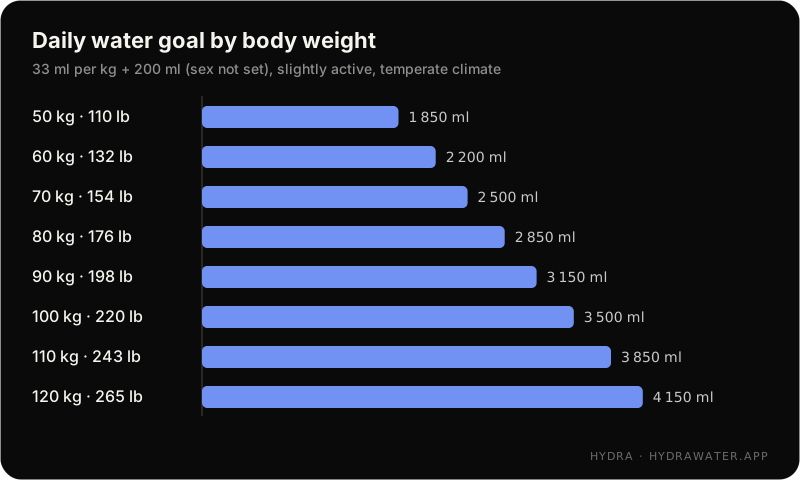
Take someone of 70 kg (154 lb), slightly active, sex not set. On a mild day their goal is 2 500 ml, about 85 oz. On a 32 °C (90 °F) day it becomes 3 000 ml, about 101 oz. On a 36 °C (97 °F) day, 3 250 ml, about 110 oz. Two or three extra glasses, not a bucket.
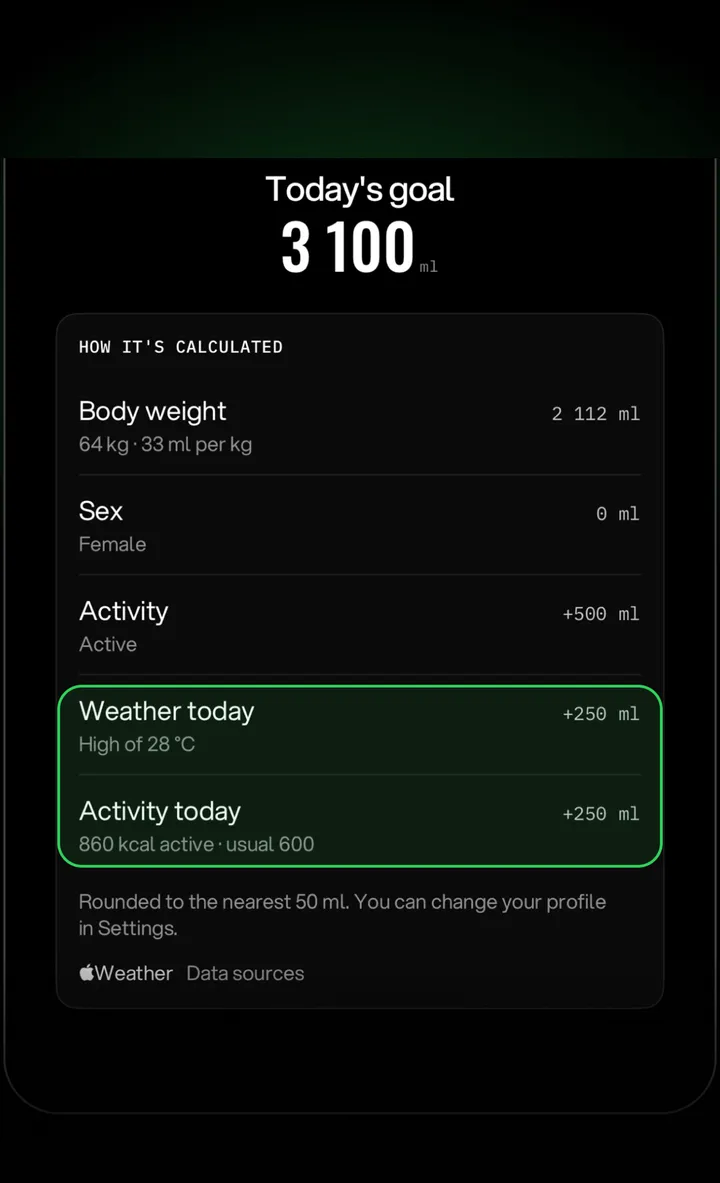
In the screenshot, a woman of 64 kg who trains three to five times a week has a high of 28 °C (82 °F). Weight, activity and heat give 2 862 ml, so 2 850. A workout above her usual adds another 250, for a 3 100 ml day. I wanted every one of those lines visible under "Goal ⓘ", so a higher goal on a hot day never feels arbitrary.
How to keep up when it's hot
Knowing the number is half of it. The other half is drinking it without forcing yourself. What works for most people:
- Start early. A glass when you wake up and one with breakfast put you ahead before the hottest hours. Catching up late in the evening is much harder.
- Spread it out. Small drinks often beat a big bottle at once. Drinking very large amounts in a short time can dilute the sodium in your blood (hyponatremia), which is dangerous.
- Carry water. If a bottle is in your bag, you'll drink from it. If you have to go looking, you'll wait until you're thirsty.
- Count every drink. Coffee, tea, sparkling water and juice all count; so does the water in fruit and vegetables.
- Electrolytes only when you sweat a lot. For a long, very sweaty day outdoors, drinks with sodium help replace the salt you lose. For a normal hot day, water is enough. More in do electrolytes hydrate better than water.
- Go easy on alcohol. A cold beer still adds a little water, but wine about breaks even and spirits take water away. Here's how much alcohol dehydrates you, drink by drink.
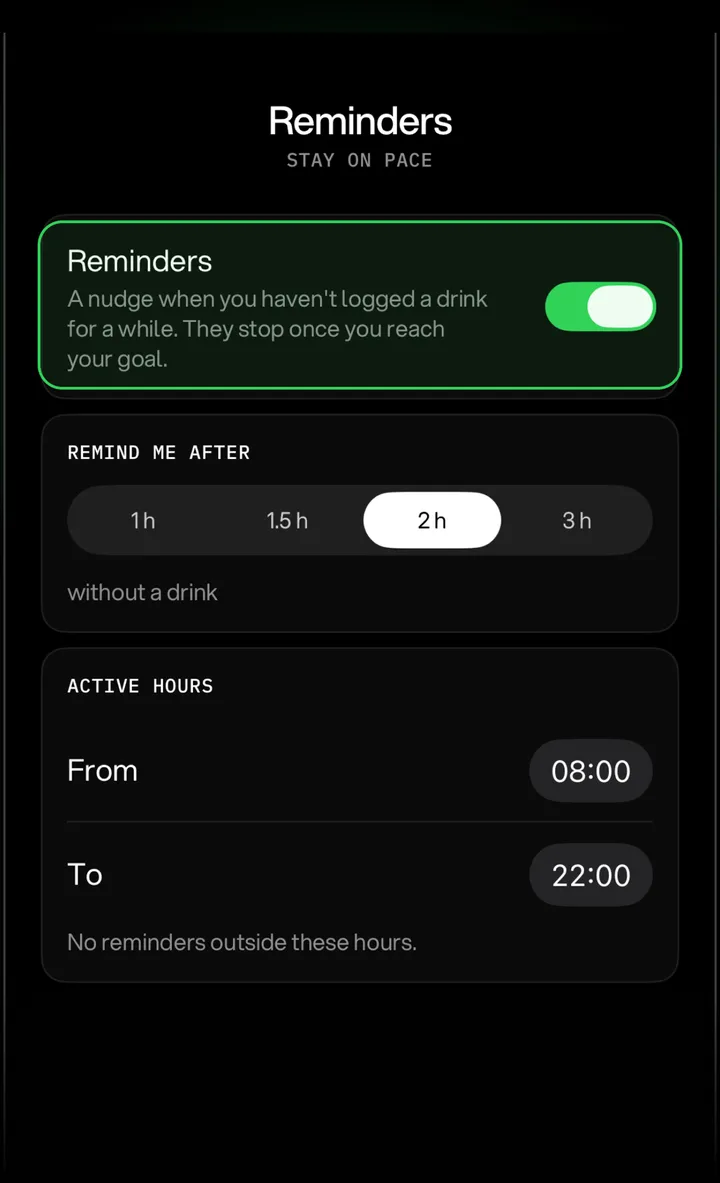
Reminders help too, as long as they don't nag. Hydra's smart reminders (Pro) only come after you've gone a while without a drink, only in your active hours, and stop once you've reached the goal. On a hot day, a nudge after two dry hours is often all it takes. I collected more ideas in habits that help you drink more water.
Stay safe in the heat
Water is one part of handling heat, not all of it. Keep to the shade when you can, wear light clothes, and move hard exercise to the cooler hours of the day. Heat illness is serious: if you, or someone with you, feels dizzy, confused or unwell in the heat, get somewhere cool and get medical help.
Everything here is about healthy adults. Some heart and kidney conditions mean you need to limit fluids even on hot days, so if that's you, follow your doctor's advice over any general number, including mine.
A goal that knows it's hot today
Hydra adds water for your climate and, with Local weather, for today's actual high, and shows you every line of the goal. Free on iPhone and Apple Watch.