No. In the amounts most people drink, coffee hydrates about as well as water, so every cup counts towards your water for the day. Studies that compared coffee with water found no difference.
What the studies found
Does coffee dehydrate you? The cleanest test is a 2014 study of fifty men who drink coffee every day. For three days they drank four mugs of coffee a day; for another three days, four mugs of water instead, with everything else the same. Their hydration was measured with total body water, blood tests and urine. The coffee days and the water days came out the same.
A larger 2016 study compared 13 drinks. Volunteers drank about a litre of each on different days, and the researchers measured how much their bodies kept over the next four hours: the beverage hydration index. Coffee, tea, cola and sports drinks were kept as well as still water. Milk, orange juice and oral rehydration solution were kept even better, thanks to their protein, sugar and salts.
Together they answer the practical question: a cup of coffee adds to your water for the day, just like a cup of water.
Where the myth comes from
It isn’t made up. Caffeine is a mild diuretic: in large doses it makes the kidneys pass a little more urine for a while. The effect is strongest in people who rarely have caffeine, and fades in daily coffee drinkers as the body gets used to it.
What the myth forgets is the cup itself. Coffee is almost entirely water, and in normal amounts that water is far more than the little extra the caffeine sends to the kidneys. The net result is positive, and close to water.
What about tea?
Tea gets the same bad reputation for the same reason: it has caffeine too. The answer is the same. In the beverage hydration index study, tea was kept as well as still water over four hours, so a mug of tea counts towards your day like a mug of water. Your breakfast tea counts in full.
When I set up the drinks in Hydra, coffee and tea were the easiest decisions. The studies left little room for doubt, so both count ×1, exactly like water. I didn’t want people drinking a glass of water “to make up” for their morning coffee, because they don’t need to.
Espresso, decaf, iced coffee and lattes
Every kind of coffee counts by its volume. What changes from one cup to another is how much liquid is in it, and sometimes how much milk.
- Espresso: a 30 ml (1 oz) espresso adds 30 ml. It counts, it’s just small.
- Filter coffee or an Americano: a 250 ml (8.5 oz) mug adds 250 ml.
- Iced coffee: counts by what you drink, ice melt included.
- Decaf: almost no caffeine, so the question doesn’t even come up. It counts like water.
- Latte or flat white: mostly milk. In Hydra you can log it as milk, which counts ×1.2.
Milk is the one I thought about longest. The 2016 study measured it at about 1.5 times water, but with that number a large latte would count for much more than you drank. I settled on 1.2: milk still counts a bit more than water, without inflating the day of someone who drinks milky coffee. If you’re curious about the details, I wrote about whether milk hydrates better than water.
How much each drink counts in Hydra
Hydra tracks net hydration: every drink is multiplied by a hydration factor, how much of it your body keeps. Here is the full list, with what a 250 ml cup of each adds:
| Drink | Counts as | 250 ml adds |
|---|---|---|
| Water, coffee, tea | ×1 | 250 ml |
| Soda, fresh juice, sports drink | ×1 | 250 ml |
| Milk | ×1.2 | 300 ml |
| Electrolytes | ×1.5 | 375 ml |
| Beer (5%) | ×0.6 | 150 ml |
| Wine (12%) | ×0 | 0 ml |
| Spirits (40%) | ×−2.2 | −550 ml |
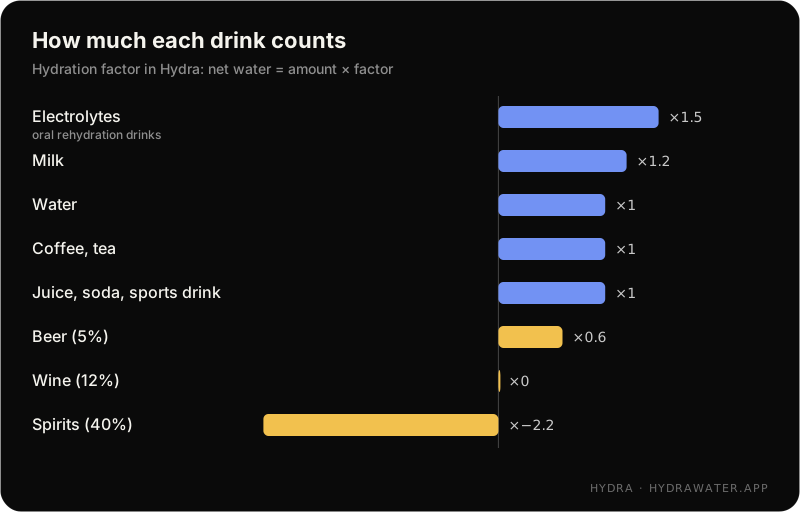
Alcohol is where things really change. Each gram of alcohol makes you lose about 10 ml of extra urine, so the stronger the drink, the less it counts: beer still adds a little, wine about breaks even, and spirits take water away. Past about 20 g of alcohol a day, Hydra counts only the alcohol’s cost and tells you how much water brings you back. That is the drink that really dehydrates you, and I explain it in does alcohol dehydrate you, beer vs wine vs spirits.
How your coffee shows up in the app
You log a coffee the same way as a glass of water: pick Coffee, pick the amount. The day view lists every drink with its amount, its factor and what it added, so you can see your coffee pulling its weight next to your water.
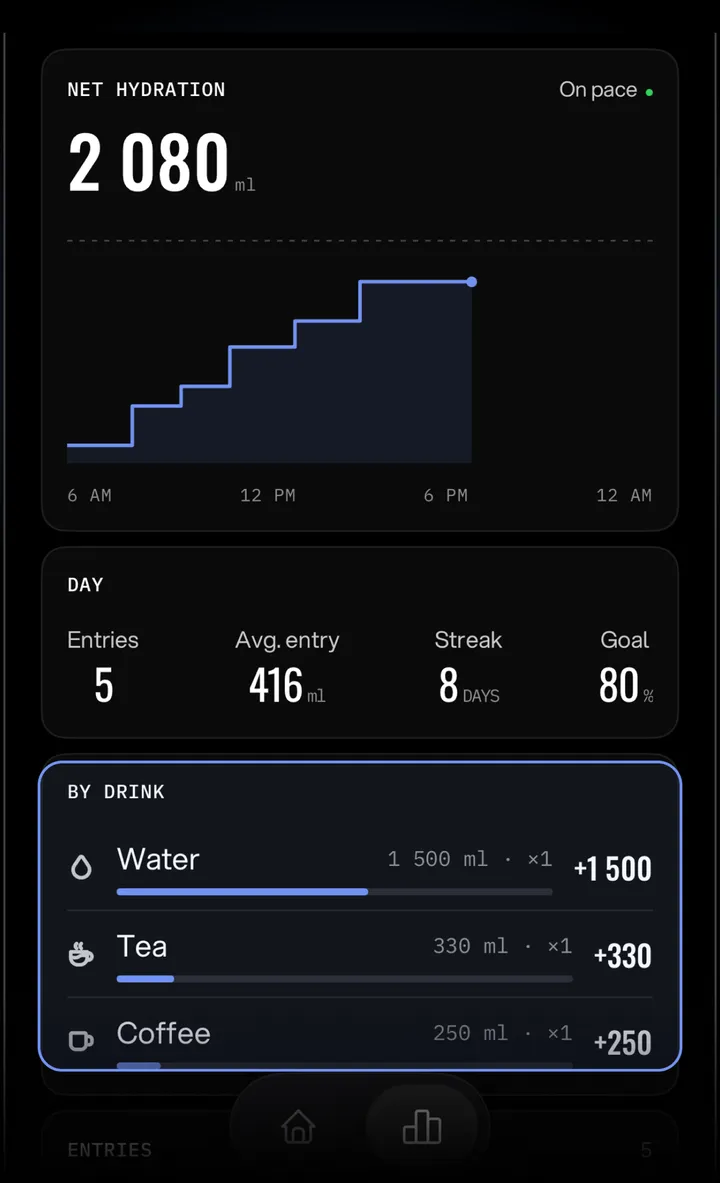
Your progress counts the coffee too. Sippy, the water drop in Hydra, fills with your net hydration, and its face shows whether you’re behind, on pace or done for the day. A morning coffee moves it just like a glass of water.

How much coffee is too much?
For hydration, coffee in normal amounts isn’t a problem, as the studies above show. How much caffeine is fine for you is a different question, about sleep and how you feel, not about water. It depends on the person, so if you’re unsure, ask your doctor. This article is about hydration for healthy adults only.
What to take from it
- Count coffee and tea towards the water you drink in a day.
- You don’t need a glass of water “to make up” for each coffee.
- If you rarely drink coffee, a very large dose of caffeine may send you to the bathroom a bit more for a few hours. It won’t undo the water in the cup.
- Milky coffees count at least as much as their volume.
- Caffeine has other effects, on sleep for example. That’s a separate question from hydration.
If coffee is already a habit, it’s a good anchor for the rest of your day; I collected a few more ideas in habits that help you drink more water. And if you’re wondering how much you should drink in total, see how much water to drink for your weight, or let the water intake calculator work out your daily goal from your weight, sex, activity and climate, with the same formula as the app.

Count every drink by what it’s worth
Hydra counts coffee, tea, milk and alcohol by how much they really hydrate, so your day adds up right. Free on iPhone and Apple Watch.