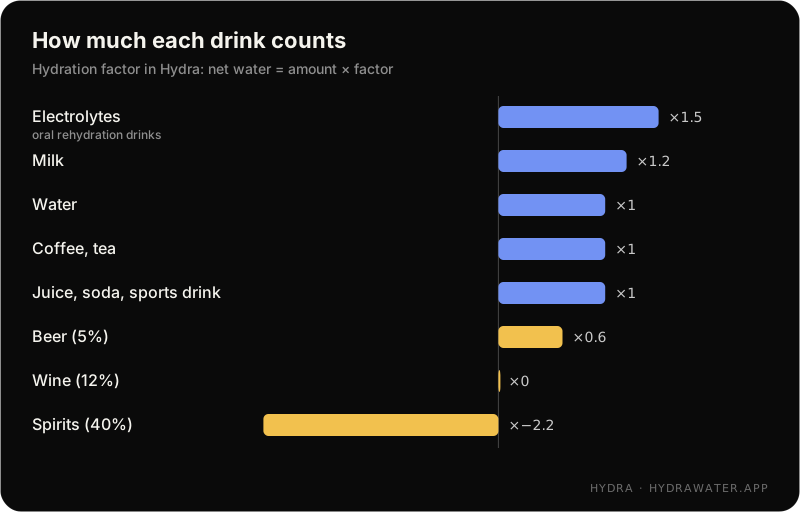
Yes. Each gram of alcohol makes you pass about 10 ml of extra urine, so the stronger the drink, the more water it costs. Per ml, beer still hydrates a little (×0.6), wine about breaks even (×0) and spirits take water away (×−2.2). Per drink, once you’re past about 20 g of alcohol in a day, every drink costs water, and a large beer costs the most because it holds the most alcohol.
Why alcohol makes you lose water
Does alcohol dehydrate you? It does, through your kidneys. For a while after you drink, they let more water go than usual, so you pass more urine than you otherwise would. The classic measurement comes from a 1942 study by Eggleton: about 10 ml of extra urine for every gram of alcohol.
That one number explains almost everything else in this article. What costs you water is the alcohol, so the size of the glass matters less than how many grams of alcohol are in it. To get grams, multiply the volume by the strength, then by 0.789, the weight of one ml of pure alcohol in grams:
- a 500 ml (17 oz) beer at 5%: 25 ml of alcohol, about 20 g;
- a 150 ml (5 oz) glass of wine at 12%: 18 ml of alcohol, about 14 g;
- a 40 ml (1.4 oz) shot of spirits at 40%: 16 ml of alcohol, about 13 g.
So a big beer, a glass of wine and a shot hold surprisingly similar amounts of alcohol. What’s very different is how much water comes with it.
From 10 ml per gram to a factor for each drink
In Hydra every drink has a hydration factor, and net water is simply the amount times the factor. Water, coffee and tea count ×1, and electrolyte drinks count ×1.5 because the body keeps them better. For an alcoholic drink I start from the same ×1, as if all the liquid in the glass were water, and subtract what its alcohol costs.
One ml of a drink at a given strength holds 0.789 × strength grams of alcohol, and each gram costs about 10 ml. That gives one formula:
factor = 1 − 0.789 × strength × 10
- Beer at 5%: 1 − 0.789 × 0.05 × 10 = 1 − 0.39 = 0.61, so beer counts ×0.6.
- Wine at 12%: 1 − 0.95 = 0.05, so wine counts ×0.
- Spirits at 40%: 1 − 3.16 = −2.16, so spirits count ×−2.2.
Run the same formula and the factor reaches zero at about 12.7%. Anything weaker still brings more water than its alcohol costs; anything stronger takes more than it brings. Wine sits almost exactly on that line, which is why a glass of wine about breaks even.
Beer vs wine vs spirits: per ml and per drink
There are two fair ways to compare them, and they give different answers.
Per ml, the ranking is simple: the stronger the drink, the worse. Every ml of beer still adds 0.6 ml of water, every ml of wine adds about nothing, and every ml of spirits costs you more than 2 ml.
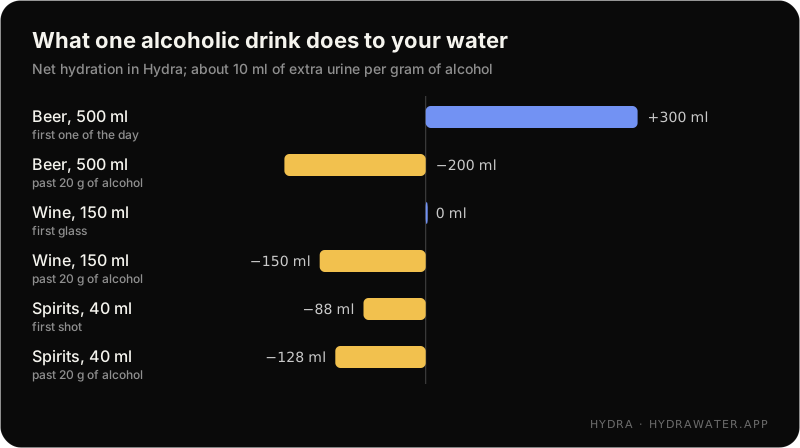
Per drink, servings matter. Nobody drinks spirits by the pint, and a typical serving of each holds 13 to 20 g of alcohol. In Hydra the result also depends on whether the drink falls within the day’s 20 g allowance, which I explain below.
| Drink | Alcohol | Factor | First of the day | Past 20 g |
|---|---|---|---|---|
| Beer 5%, 500 ml | ≈20 g | ×0.6 | +300 ml | −200 ml |
| Wine 12%, 150 ml | ≈14 g | ×0 | 0 ml | −150 ml |
| Spirits 40%, 40 ml | ≈13 g | ×−2.2 | −88 ml | −128 ml |
So which drink dehydrates you most? As a first drink, spirits: a shot is the only one that takes water away from the start. Past the allowance, the water in the drink no longer counts, and each drink costs about 10 ml per gram of alcohol. Then the large beer costs the most, about 200 ml, simply because it holds the most alcohol. Beer’s water protects you only for the first one.
Why Hydra has a 20 g allowance
The factors alone had a flaw. At ×0.6, five large beers would add 1.5 litres of water to your day, and you could reach your goal on beer. So alcohol gets a daily allowance of 20 g, about one 500 ml beer. Within it, drinks count with the factors above. Past it, the water in the drink stops counting and only the alcohol’s cost is left: beer ×−0.4, wine ×−1, spirits ×−3.2, each factor minus one.
The allowance is not a safe-drinking limit or a recommendation. It is only the point where Hydra stops counting the water in alcoholic drinks. For the practical side, how much water to drink with each beer, glass or shot and when, I wrote a separate guide on how much water to drink after alcohol, with worked examples for a night out.
Is 10 ml per gram too strict?
Possibly, for some drinks. The 1942 figure is old, and newer research found a smaller effect in some cases. A 2017 study by Polhuis and colleagues compared weak and strong alcoholic drinks in older men. And in the beverage hydration index study from 2016, volunteers drank about a litre of each of 13 drinks, and researchers measured how much their bodies kept over four hours: lager was not different from still water, just like coffee, tea and cola.
When I built Hydra, I had to pick one number for every beer, glass and shot, and I picked the cautious one on purpose. If it’s a little too strict, you drink a glass of water you didn’t strictly need. If it were too generous, the app would tell you you’re fine when you aren’t. A glass of water costs nothing, so I’d rather err on that side.
What you see in Hydra
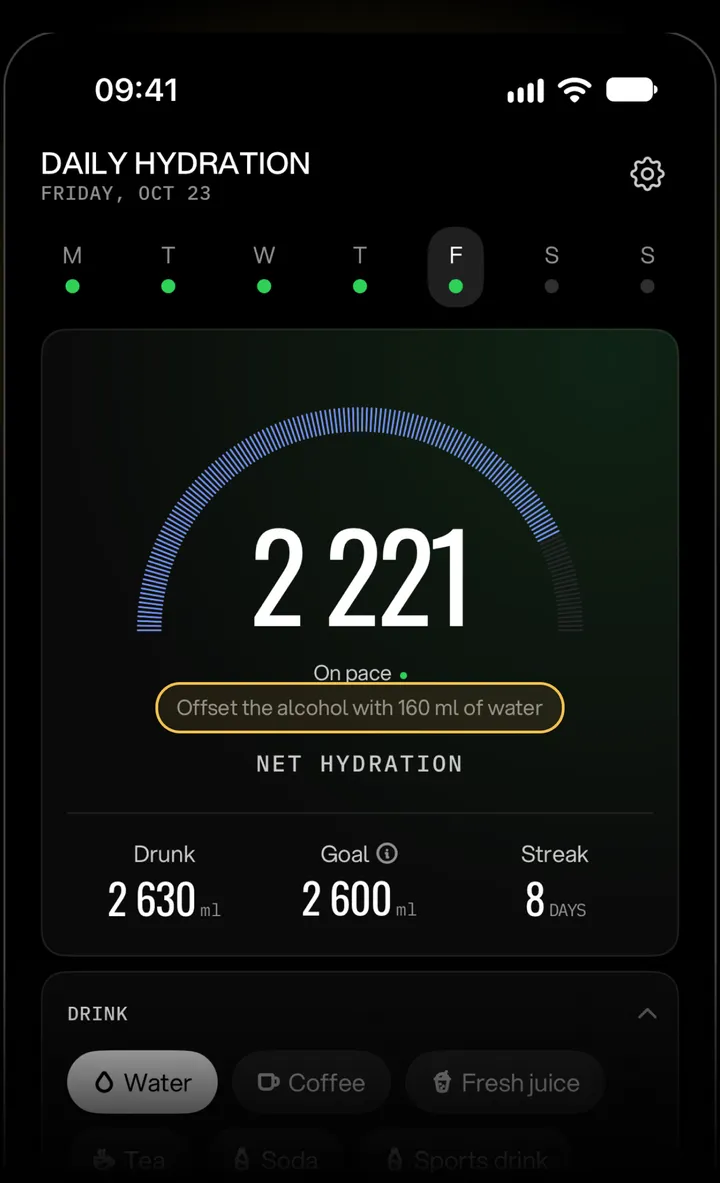
You log a drink by its type and amount, and Hydra does the maths. Today shows how much you drank and your net hydration, what really counts once every factor is applied. When alcohol takes water away, a hint tells you how much water offsets it.
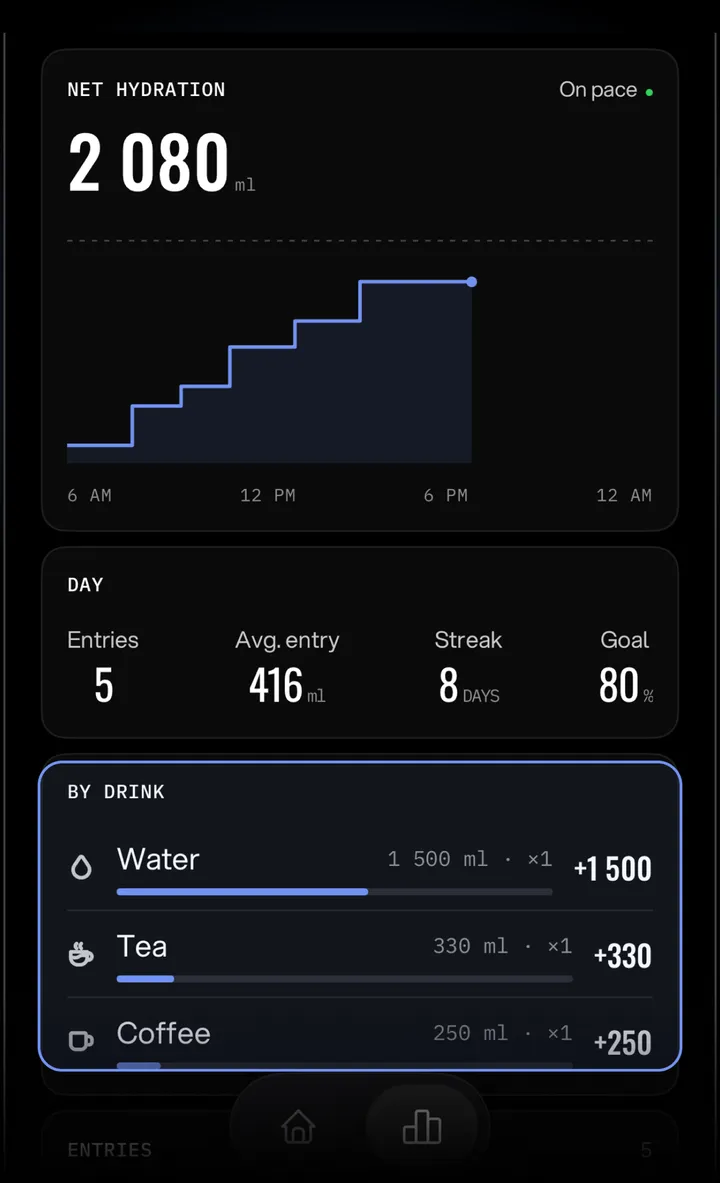
The day view lists every drink with its amount and its factor, so you can see exactly what each one added or took away. Non-alcoholic drinks are simpler: coffee hydrates about as well as water, despite its reputation, and milk counts a little more than water.
What to take from it
- Alcohol makes you lose water through your kidneys, about 10 ml per gram, on the cautious estimate.
- Strength matters more than volume: beer ×0.6, wine ×0, spirits ×−2.2.
- A first beer still hydrates a little, wine breaks even, a shot always costs water.
- Past about one large beer’s worth of alcohol, every drink costs water, roughly a glass each.
- Water replaces the fluid alcohol takes; it doesn’t undo alcohol’s other effects.
Your daily target stays the same on days you drink; the alcohol just lowers what counts towards it. You can work out your daily water goal from your weight, sex, activity and climate with the same formula the app uses. All of this is for healthy adults. If you have a medical condition or take medication, ask your doctor about alcohol and fluids.

See what each drink really adds
Hydra counts beer, wine and spirits by what they cost you in water, and shows how much water brings you back. Free on iPhone and Apple Watch.