To drink more water, know your daily goal, keep a cup you like within reach, and tie drinks to things you already do: waking up, meals, coffee breaks. Spread them through the day, use reminders that only come after a long gap, and count coffee, tea and other drinks too. You don't need to force yourself past thirst.
1. Know your number
"Drink more" is hard to act on. "Drink 2.5 litres today" is easy. The popular rule of eight glasses a day has no scientific origin anyone has been able to trace, and a large 2022 study found it too high for many people and too low for others (more in whether you need 8 glasses of water a day).
A better start is a goal built on your own body. The water intake calculator works it out from your weight, sex, activity and climate, with the same formula Hydra uses. For an adult of 70 kg (154 lb), slightly active, that's about 2 500 ml a day, or 85 oz: ten glasses of 250 ml.
2. Use a cup you actually like
It sounds trivial, but the glass or bottle you reach for decides a lot. Pick one you like holding, and learn its size. Once you know your bottle is 500 ml, "two of these by lunch" is a plan you can keep in your head.
That's also why Hydra has custom cups (Pro): you set the amounts you really drink from, and they show up in the Amount grid, so logging matches your mug and not a generic glass.
3. Tie drinks to things you already do
A new habit is easier to remember when it hangs on an old one. You already wake up, eat, make coffee and come home every day; each of those can carry a glass of water. Here is what a 2 500 ml day looks like when it rides on a normal routine:
| Moment | Drink | Day so far |
|---|---|---|
| Waking up | 250 ml | 250 ml |
| Coffee or tea at breakfast | 250 ml | 500 ml |
| Sitting down to work | 250 ml | 750 ml |
| Mid-morning break | 250 ml | 1 000 ml |
| Lunch | 500 ml | 1 500 ml |
| Afternoon coffee or tea | 250 ml | 1 750 ml |
| Coming home | 250 ml | 2 000 ml |
| Dinner | 250 ml | 2 250 ml |
| Evening | 250 ml | 2 500 ml |
None of those moments needs willpower. They're already in your day; the water just comes along.
4. Spread it through the day
Drinking little and often is easier than drinking a lot at once, and kinder to your evening. If you get to 6 pm with half your goal left, the rest turns into a chore, and more trips to the bathroom late at night.
That's why the Today screen in Hydra doesn't only show how much you've drunk; it shows whether you're on pace for the time of day. Half your goal at 3 pm is fine. Half your goal at 9 pm means it's time to catch up a bit, not to down a litre before bed.
5. Keep water where you can see it
A full glass on your desk gets drunk. A bottle in the bag gets drunk on the train. Water you have to go and get usually waits until you're thirsty. Put it in the places where you spend your day: desk, car, bedside, gym bag.
6. Use reminders that respect you
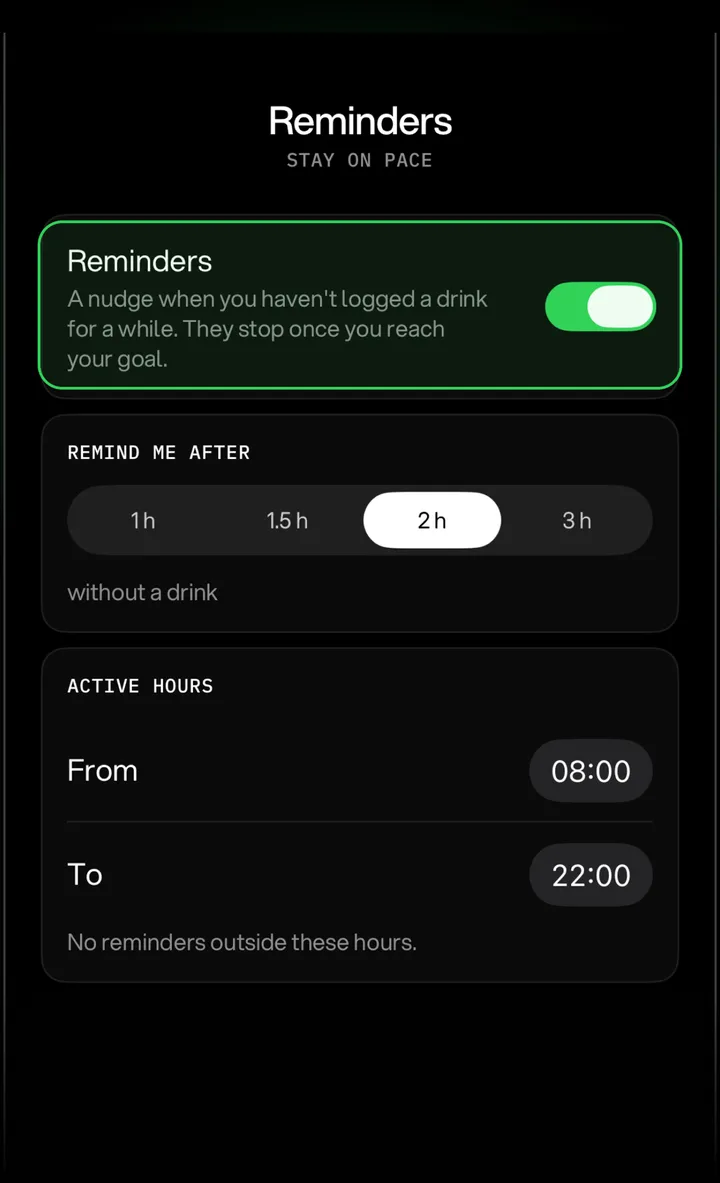
A reminder every hour, whether you've just had a glass or not, is easy to start swiping away without reading. When I built Hydra's smart reminders (Pro), I wanted the opposite: a reminder should only come when it's actually useful.
- Only after a gap. You get a reminder only after you've gone a while without a drink: 1, 1.5, 2 or 3 hours, 2 hours by default. Drink at 10:00 and the clock starts again.
- Only in your active hours. By default 08:00 to 22:00. Nothing while you sleep.
- Never after the goal. Once you've reached it, Hydra stops reminding you for the day. Done is done.
- One tap to log. "Add 250 ml of water" sits right in the notification, so you don't even have to open the app.
7. Make logging take one tap
If tracking takes effort, you stop tracking, and then you stop noticing. So I tried to put a "log a drink" button everywhere you already look. Hydra's Home Screen and Lock Screen widgets show your progress and let you log a drink with a tap. Press and hold the app icon and you can add a glass of water without opening the app.
The watch is the quickest of all: one tap on your wrist, even mid-workout. I wrote a step-by-step guide on tracking your water intake on Apple Watch.
8. Count everything you drink
Many people think only plain water counts, so they feel behind even when they're not. In fact, coffee and tea hydrate about as well as water in normal amounts (here's why coffee doesn't dehydrate you). Sparkling water counts the same as still; I looked at it closer in does sparkling water hydrate you. Milk, juice and soups all bring water too. Alcohol is the exception: the stronger the drink, the less it counts.
Food helps as well. Health bodies estimate that about 20–30% of the water you take in comes from what you eat; I explain how that fits with your goal in does food count towards your water intake. Hydra's goal is for drinks only, so what you eat is a bonus on top.
9. Make your progress something you can see
A number is easy to ignore. A small face isn't. That's why I made Sippy: a water drop that fills up as you drink, with a face that shows how you're doing. Its face changes with your pace: behind, on pace, goal reached. Sippy lives in the app, in the widgets and on the watch, so a glance is enough to know where you stand.
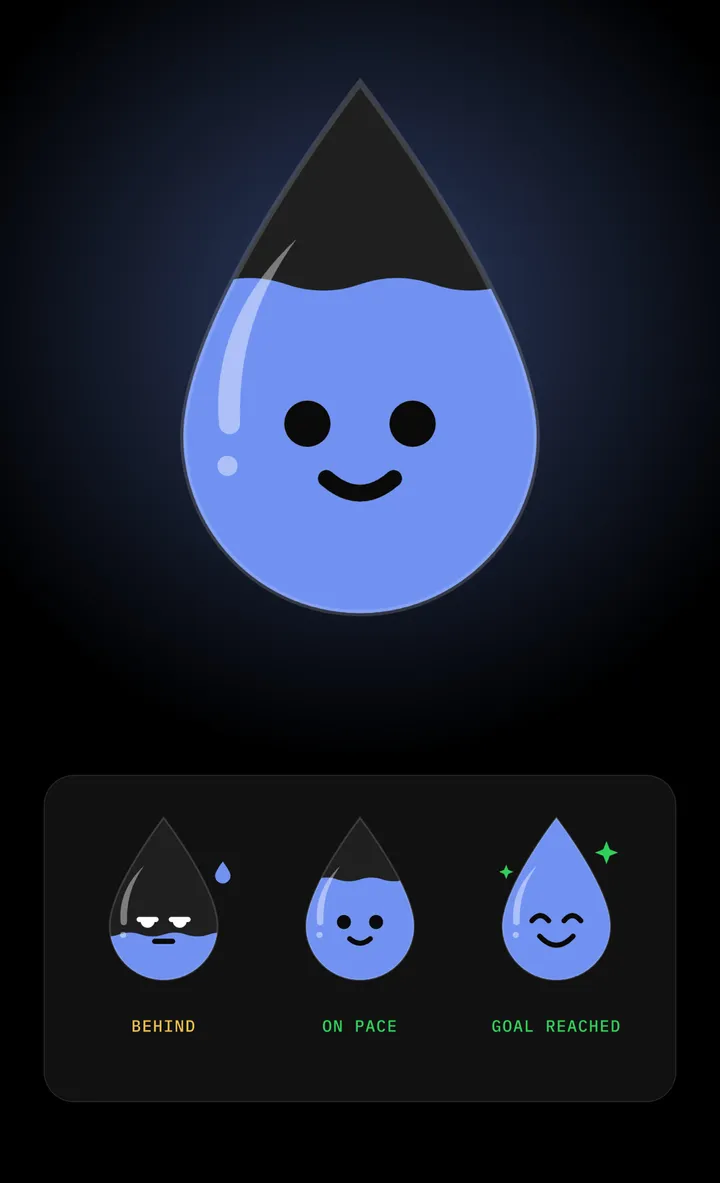
If you prefer something plainer, you can switch to a classic gauge. Both show the same thing: how far along you are, for the time of day.
10. Look back once a week
A habit is built over weeks, not in a single day. Once a week, have a look at how it went: your daily average, how many days you reached the goal, your best streak. You'll often spot a pattern, like weekends dropping off, or mornings that start too late. That's the thing to fix next.
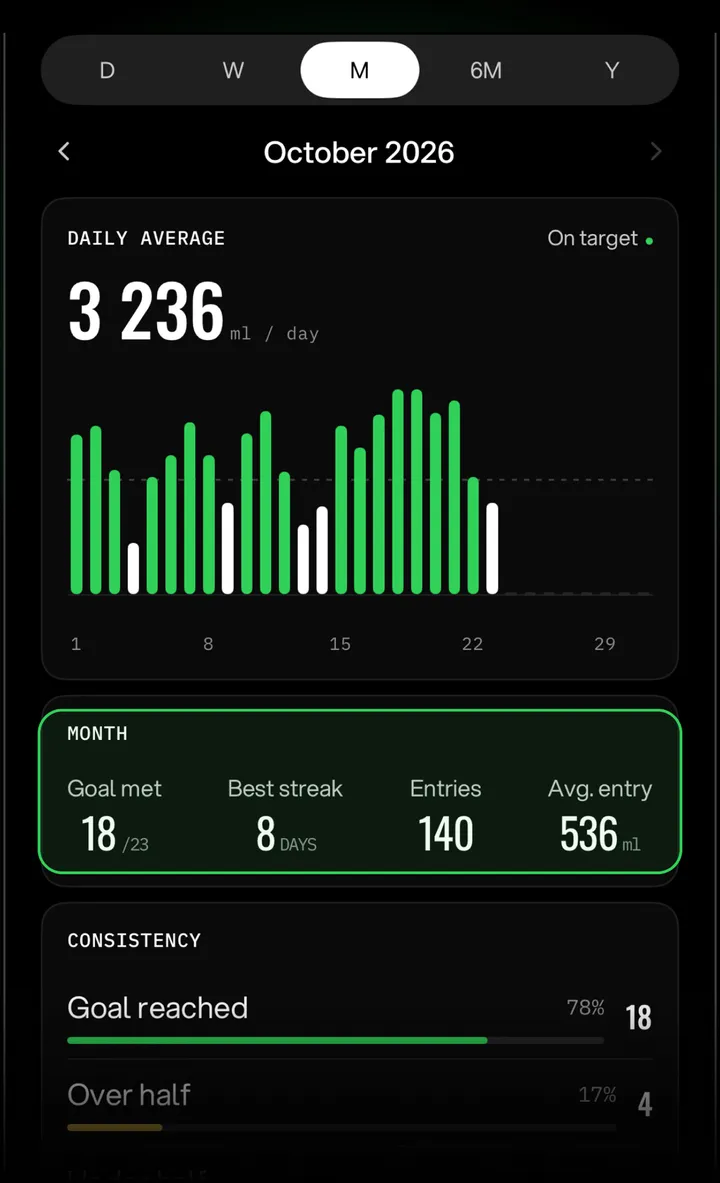
And don't chase perfection. A missed day doesn't undo the habit. Aim for most days, not every day.
Don't overdo it
More water is not always better. Drinking very large amounts in a short time can dilute the sodium in your blood (hyponatremia), which is dangerous. Spread your drinks over the day and don't force yourself far past thirst. Your goal is a guide for a normal day; on hot days you need more water, and when you exercise too.
This is about healthy adults. Some heart and kidney conditions mean you need to limit fluids, so if that applies to you, follow your doctor's advice first.
Make drinking water a habit
Hydra gives you a goal that fits you, reminders that know when you've already had a drink, and Sippy to keep you company. Free on iPhone and Apple Watch.